HR as the New Growth Engine: Inside India’s Global Capability Center Revolution
India’s Global Capability Center (GCC) ecosystem has moved far beyond its back-office origins. Discover how strategic Human Resources is driving transformation, talent acquisition, and global ownership.
Build a Future-Ready GCC Workforce
Scale Smarter with Kas Business Consulting
India’s Global Capability Center (GCC) ecosystem has moved far beyond its back-office origins. Today, GCCs in India are innovation hubs, product-engineering powerhouses, and strategic decision-making centers for global enterprises, and at the heart of this shift sits one function doing the heavy lifting: Human Resources.
As organizations race to scale their GCC operations in India, HR is no longer a support desk. It’s the architecture behind every successful GCC setup, talent strategy, and workforce transformation initiative. At Kas Business Consulting, we work closely with global enterprises navigating this shift, and the data tells a clear story: HR strategy is now GCC strategy.
Why GCC India Is the World’s Talent Powerhouse
India hosts one of the largest and fastest-growing concentrations of GCCs globally, spanning technology, BFSI, life sciences, retail, and manufacturing. This growth isn’t accidental; it’s the result of a deep, diversified talent pool, cost-efficient scaling, and a maturing ecosystem of HR consulting in India that helps multinational companies set up, staff, and run centers of excellence from day one.
For HR leaders, this means the mandate has expanded from filling seats to owning global capability, culture, and continuity, from the boardroom to the bench.
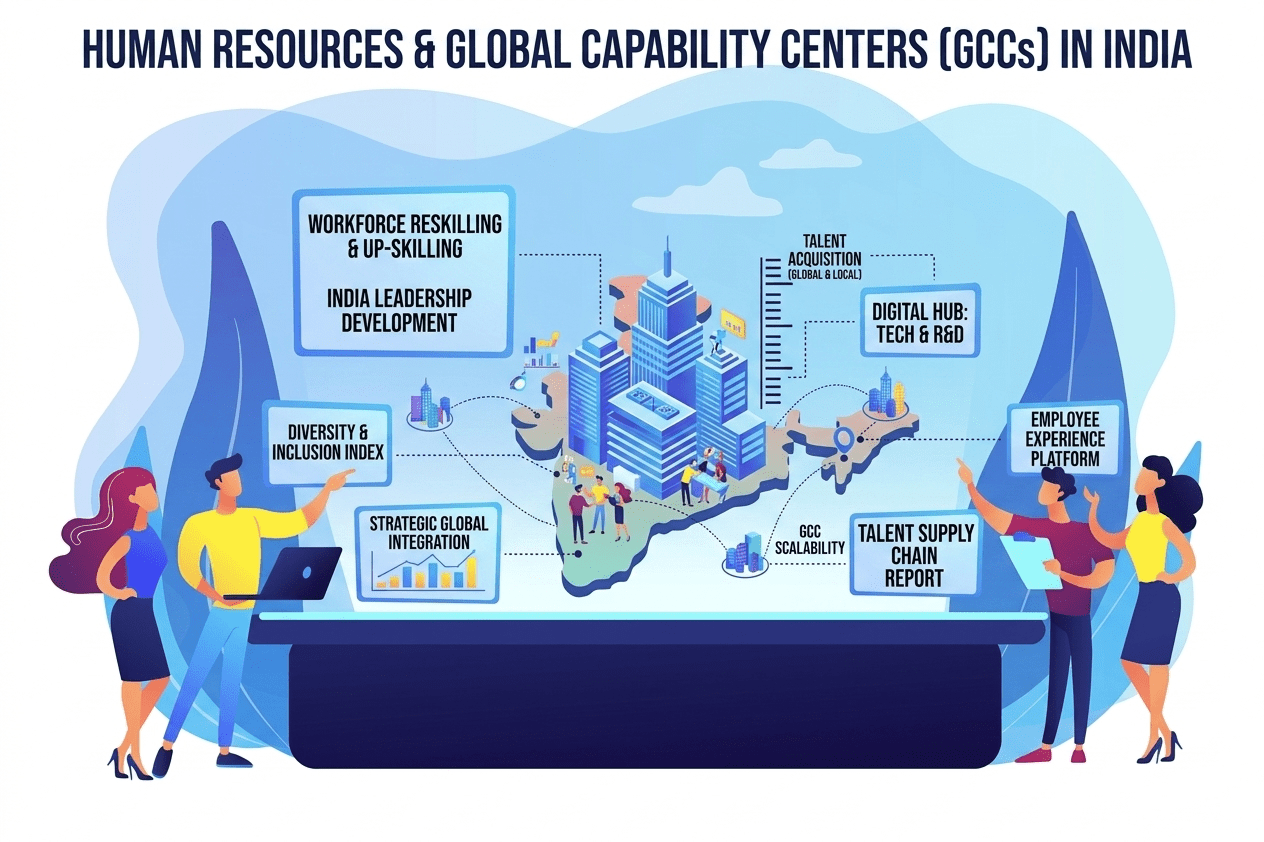
The Five Pillars of HR-Led GCC Growth
How progressive HR functions are structuring workforce excellence across Indian capability centers:
1. Strategic Talent Acquisition
GCC hiring trends in 2026 are dominated by demand for AI/ML engineers, cloud architects, cybersecurity specialists, and data scientists. Competitive talent acquisition strategies now combine employer branding, niche-skill sourcing, and speed-to-hire models to compete with product companies and startups for the same talent pool.
2. Workforce Transformation & Reskilling
The future of the GCC workforce in India depends on continuous upskilling. Structured reskilling pipelines, especially in AI, automation, and cloud-native development, are helping organizations future-proof teams rather than constantly rehire for new capabilities.
3. Employee Engagement & Digital-First Culture
Retention in a hyper-competitive market hinges on experience, not just compensation. GCCs investing in digital-first engagement, transparent career pathways, and flexible work models are seeing measurably stronger retention outcomes.
4. Leadership Development for Global Ownership
As Indian GCCs take on P&L accountability and product ownership, HR is building leadership pipelines capable of managing cross-border teams, global stakeholders, and matrixed reporting lines, not just local operations.
5. HR Digital Transformation
AI in HR, people analytics, and automation are converging to reshape the entire employee lifecycle:
- AI in HR: Smarter, faster recruitment and hyper-personalized onboarding and employee experiences.
- People Analytics: Predictive insights for hiring, attrition risk, and performance mapping.
- HR Automation: Freeing HR teams from repetitive administrative work to focus on strategic, high-value initiatives.
Key Insights: What the GCC Talent Landscape Tells Us
- Skills over headcount: Hiring priorities have shifted decisively toward AI, data, and cloud competencies rather than pure volume hiring, a defining GCC hiring trend for 2026.
- Retention is a design problem, not a perk problem: Centers with strong internal mobility and digital engagement tools consistently outperform peers on retention.
- HR-business alignment is the biggest lever: The GCCs seeing the fastest scale-up are those where HR sits inside strategic planning, not downstream of it.
- Well-being and hybrid work are now baseline expectations: These are no longer differentiators; organizations lagging here face a widening talent gap.
- Data-backed decisions win: Companies using people analytics and structured talent intelligence report faster, more confident hiring and workforce-planning decisions.
India’s Leading GCC Hubs: Where the Talent Battle Is Won
Not all GCC growth looks the same across India; each hub brings a distinct talent proposition, and HR strategies increasingly need to be city-specific rather than one-size-fits-all:
| GCC Hub City | Core Talent Focus & Ecosystem Advantage |
|---|---|
| Bengaluru | India’s original GCC hub, still the deepest bench for AI/ML, cloud, and product engineering talent, though also the most fiercely contested for niche skills. |
| Hyderabad | A fast-growing magnet for life sciences, BFSI, and enterprise technology GCCs, backed by strong infrastructure and a widening leadership talent pool. |
| Pune | Popular for engineering, manufacturing-tech, and R&D-heavy GCCs, with a growing focus on embedded systems and automotive software talent. |
| Chennai | Emerging strength in BFSI, healthcare-tech, and core engineering, with comparatively lower attrition in several segments. |
| NCR (Gurugram/Noida) | A hub for consulting-adjacent GCCs, digital marketing technology, and enterprise SaaS capability centers. |
| Tier-2 Cities | (Coimbatore, Indore, Jaipur, Ahmedabad) An emerging frontier for GCC expansion offering access to fresh talent pools and lower cost structures, though HR must invest more deliberately in employer branding and leadership pipelines here. |
For HR leaders, location strategy is now a talent strategy decision, not just a real-estate one. This is precisely where structured GCC setup and expansion consulting adds the most value: matching skill availability, cost economics, and long-term scalability to the right city.
DEI, Hybrid Work, and Well-Being: From “Nice to Have” to Core Strategy
Three themes that used to sit in the “future-ready” category are now table stakes for any GCC serious about talent retention:
Diversity, Equity & Inclusion (DEI)
GCCs with structured DEI programs (inclusive hiring panels, pay-equity audits, and representation targets at leadership levels) report stronger employer brand pull, particularly among early-career and women returnee talent segments.
Hybrid Work Models
Rigid return-to-office mandates are increasingly at odds with candidate expectations. GCCs that offer structured hybrid frameworks (clear in-office cadence, flexible hours, and outcome-based performance metrics) are better positioned in competitive offer negotiations.
Employee Well-Being
Mental health support, manageable workloads, and burnout prevention are now factored into employer-brand perception scores. HR teams embedding well-being into performance and engagement frameworks, not treating it as a standalone wellness initiative, see the strongest impact on retention.
Frequently Asked Questions
What is a Global Capability Center (GCC)?
A GCC is an offshore or nearshore unit set up by a global enterprise to deliver technology, operations, R&D, or strategic functions, increasingly with full ownership of products, platforms, and decision-making rather than purely support work.
Why is India a preferred destination for GCCs?
India offers a large, skilled, English-speaking talent pool across technology and business functions, cost efficiency at scale, mature operating infrastructure, and a growing base of specialized HR and consulting partners who support fast, structured GCC setup.
What skills are most in demand in Indian GCCs in 2026?
AI/ML engineering, cloud architecture (AWS, Azure, GCP), cybersecurity, data engineering and analytics, and product management are among the highest-demand roles, alongside functional leadership talent capable of managing global stakeholders.
How does HR consulting help in setting up a GCC in India?
HR consulting partners like Kas Business Consulting support location selection, workforce planning, hiring model design, compensation benchmarking, and engagement strategy, helping organizations avoid costly missteps during setup and early scale-up phases.
What role does people analytics play in GCC workforce planning?
People analytics helps HR teams predict attrition risk, benchmark compensation, forecast hiring needs, and measure engagement, turning workforce decisions from reactive guesswork into proactive, data-backed strategy.
Looking Ahead: What HR Leaders Should Prepare for Beyond 2026
- Deeper AI integration into HR itself: From resume screening to predictive attrition modelling becoming standard, not experimental.
- Skills-based hiring over degree-based hiring: Competency frameworks increasingly replacing traditional qualification filters.
- GCCs as innovation owners: More centers moving from execution mandates to full product and R&D ownership, requiring HR to build genuine innovation cultures.
- Tier-2 city expansion accelerating: HR playbooks will need localized employer branding and leadership-development strategies to succeed outside the traditional metro hubs.
- Continued convergence of HR and business strategy: The GCCs that outperform will be the ones where HR has a seat at the strategic table from day one.
Navigating the Challenges Ahead
HR leaders scaling GCCs in India face three consistent hurdles:
- Niche Talent Competition: Specialized AI, cloud, and cybersecurity talent remains scarce and highly contested.
- Global-Local Alignment: Bridging local execution with global HQ strategy requires structured governance, not ad-hoc coordination.
- Innovation Ownership: Positioning HR as a catalyst for R&D and product innovation, not just a compliance function.
How Kas Business Consulting Helps GCCs Scale Smarter
Kas Business Consulting partners with organizations across the full GCC lifecycle, from location strategy and setup to HR transformation and long-term talent intelligence:
Consulting Services
- GCC Setup & Expansion: Location strategy and operational frameworks
- HR Consulting: Hiring models, engagement, and retention design
- Market Research: Hiring trend benchmarks and competitive intelligence
Data & Intelligence Solutions
- Comprehensive Database: Curated company and market trend data
- Talent Intelligence: Actionable people-analytics insights
- Lead Generation: Structured data to identify growth opportunities
Ready to Build a Future-Ready GCC Workforce Strategy?
Explore how Kas Business Consulting’s talent intelligence and HR consulting solutions can help you scale smarter.